Best Budget USB Microphones Under $100 in 2026
Last updated: 2026-09-03 · By NicheHive Editorial
This article contains affiliate links. If you purchase through these links, we may earn a commission at no extra cost to you. As an Amazon Associate, NicheHive earns from qualifying purchases. See our full disclosure.
You can get a genuinely good USB microphone for under $100. These three deliver clean audio for streaming, video calls, and podcasting without requiring a $150+ investment.
Our Top Picks

Audio-Technica AT2020USB+
Audio-Technica
- ✓Cardioid condenser
- ✓Flat 20Hz-20kHz frequency response
- ✓High-quality A/D converter
- ✓Mix control for monitoring
- ✓Headphone monitoring
Pros
- Most accurate frequency response of any USB microphone under $100
- High-quality A/D converter — cleaner digital signal than most competitors
- Mix control lets you blend direct monitoring with playback audio
- Audio-Technica cardioid capsule quality well above price point
Cons
- Cardioid only — no polar pattern options
- No built-in processing or software
- Basic stand — boom arm strongly recommended
The AT2020USB+ is the best-sounding USB microphone under $100. The flat frequency response and quality A/D converter make it the right choice for podcast recording, voiceover, and anyone who processes audio in a DAW.
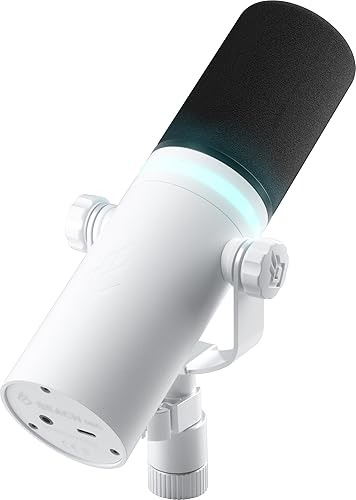
Rode NT-USB Mini
Rode
- ✓Cardioid condenser
- ✓Magnetic desktop stand
- ✓USB-C
- ✓Cross-platform (Mac, Windows, iOS, Android)
Pros
- Smallest footprint of any quality USB mic at this price
- Magnetic stand repositions in seconds without tightening anything
- USB-C is future-proof and works natively on modern laptops
- Works on iPad Pro and iPhone for mobile recording
Cons
- Slightly higher noise floor than AT2020USB+ in identical conditions
- No headphone volume control on unit
- Cardioid only
Best for small desks and cross-platform setups. The magnetic stand and USB-C connection are practical design advantages. Audio quality slightly below AT2020USB+ but meaningfully better than webcam microphones.

Samson Q2U
Samson
- ✓Dynamic cardioid capsule
- ✓USB and XLR output
- ✓On-board volume controls
- ✓Headphone monitoring
Pros
- Dynamic capsule rejects room noise better than condensers — best for untreated rooms
- XLR output allows upgrading to an audio interface without replacing the microphone
- On-board volume controls — no software required
- Most affordable quality dynamic USB microphone
Cons
- Dynamic capsule has less high-frequency detail than condenser alternatives
- No software processing
- Basic design — not streaming-aesthetic friendly
Best for untreated rooms or setups with background noise. The dynamic capsule rejects more room noise than condensers at this price. The XLR output is a unique budget feature that allows this microphone to remain useful after upgrading to an audio interface.
It's tempting to grab the cheapest USB microphone on Amazon and assume a mic is a mic. Then you listen back to the recording and hear tinny hiss under every word.
The best budget USB microphones prove you don't need to spend $150 to fix that. Somewhere between $50 and $100, recording quality stops being a gamble.
What changes at that price point? Better A/D converters, sturdier capsules, and electronics that don't add audible noise to your voice.
The Audio-Technica AT2020USB+ is our pick for best overall. At $99, it has the flattest frequency response and cleanest converter of any USB microphone under $100, the kind of accuracy you'd expect from a mic costing twice as much.
Condenser vs Dynamic at This Price
At $70-100, the choice between condenser (AT2020USB+, NT-USB Mini) and dynamic (Samson Q2U) follows the same framework as at higher price points, with one additional consideration: room treatment.
A $30-50 acoustic isolation shield behind a condenser microphone eliminates most of the room reflection that reveals untreated recording spaces. Adding this accessory to the AT2020USB+ or NT-USB Mini produces results competitive with what a dynamic delivers without treatment.
If you cannot or do not want to add treatment: dynamic (Samson Q2U). If you can add a basic isolation shield: condenser (AT2020USB+).
The XLR Question
The Samson Q2U is the only microphone in this guide with an XLR output in addition to USB. This matters for one specific scenario: you start with USB microphone recording, then upgrade to an audio interface setup without replacing the microphone.
If you anticipate upgrading to an audio interface (Focusrite Scarlett, SSL 2) within the next year, the Q2U's dual output means you keep the microphone through the upgrade. The AT2020USB+ and NT-USB Mini are USB-only — an audio interface upgrade requires purchasing a new XLR microphone.
Software Compatibility
All three microphones are class-compliant USB devices. They work on Windows and Mac without drivers. They appear as audio input devices in any software: OBS, Zoom, Teams, GarageBand, Audacity, Adobe Audition.
The Rode NT-USB Mini additionally works on iOS (USB-C to USB-C connection) and Android (USB-C to USB-C or with adapter). If mobile recording is a use case, the NT-USB Mini is the only option in this guide that supports it natively.
Boom Arm Recommendation
None of the included stands in this guide position the microphone at optimal height for desk recording. All three benefit from a boom arm.
The Heil PL2T ($90), Rode PSA1 ($99), and Elgato Wave ($60) are the quality options. For a budget under $100 that already includes the microphone, the Neewer NB-35 ($30) is the functional choice — not premium quality but adequate for desk use.
Boom arm recommendation: NEEWER NB-35 for budget builds, Elgato Wave Mic Arm Low Profile for aesthetics-first setups.
Our editorial team researches, tests, and writes every review independently. We never accept payment for placement.