Best Panel Clamps for Woodworking 2026: 8 Bar and Pipe Clamps for Gluing Panels
Last updated: 2026-08-21 · By NicheHive Editorial
This article contains affiliate links. If you purchase through these links, we may earn a commission at no extra cost to you. As an Amazon Associate, NicheHive earns from qualifying purchases. See our full disclosure.
Panel glue-ups require long, parallel clamping pressure to keep boards flat and prevent buckling. We tested 8 bar clamps, pipe clamps, and panel clamp systems on clamping force, jaw spread, and ease of use for wide glue-ups.
Our Top Picks
- #1Bessey KR3.550 50-Inch K Body REVO Parallel Bar Clamp (2-Pack)
- #2IRWIN QUICK-GRIP One-Handed Bar Clamp, Medium-Duty, 36-Inch
- #3JORGENSEN 8036 Cabinet Master 36-Inch 90-Degree Parallel Steel Bar Clamp
- #4PONY 50 Clamp Fixture for 3/4-Inch Black Pipe
- #5Bessey BPC-H34 3/4-Inch H Style Pipe Clamp
- #6TEKTON 39184 24-Inch Ratchet Bar Clamp / 30-Inch Spreader
- #7POWERTEC Strap Clamps for Woodworking, 13 ft Band Clamp (71101)
- #8JORGENSEN 8072 Cabinet Master 72-Inch 90-Degree Parallel Jaw Bar Clamp

Bessey KR3.550 50-Inch K Body REVO Parallel Bar Clamp (2-Pack)
Bessey
- ✓50-inch jaw spread
- ✓1,700 lb clamping force
- ✓Parallel jaw design — jaws stay flat under load
- ✓One-handed tightening
Pros
- Parallel jaw design maintains contact across the full jaw width — eliminates the 'banana' cupping common in budget bar clamps
- 1,700 lb clamping force is among the highest tested in the bar clamp category
- One-handed tightening allows repositioning while still holding the clamp
- German engineering — Bessey is the standard reference for professional woodworkers
Cons
- High price — the most expensive option on this list
- Heavy — each clamp weighs approximately 7 lbs at 50 inches
Best overall panel clamp. The parallel jaw design is what separates the Bessey K Body from every other bar clamp — it eliminates the jaw angle that causes pressure to concentrate at the jaw tips rather than across the full surface. Recommended for serious furniture and cabinet making.

IRWIN QUICK-GRIP One-Handed Bar Clamp, Medium-Duty, 36-Inch
IRWIN
- ✓One-handed trigger operation
- ✓600 lb clamping force
- ✓Converts to spreader
- ✓36-inch jaw spread
Pros
- Trigger operation enables one-handed clamping — essential when holding boards in position
- Converts from clamp to spreader without tools — useful for case assembly
- 600 lb clamping force adequate for most panel glue-ups
- Lowest price for a functioning 36-inch clamp
Cons
- Jaw pads can indent softwood under maximum torque — use protective pads for finished surfaces
- 600 lb force lower than Bessey K Body for demanding hardwood glue-ups
Best one-handed panel clamp. The trigger mechanism is genuinely useful when you need one hand free to hold boards flat or in position. 600 lb force is adequate for most solid wood panel glue-ups.

JORGENSEN 8036 Cabinet Master 36-Inch 90-Degree Parallel Steel Bar Clamp
Jorgensen
- ✓Patented clamping head with 90-degree alignment
- ✓No rocking — stable on flat surfaces
- ✓I-beam bar construction
- ✓Non-marring pads
Pros
- Patented head design keeps the jaw at 90 degrees to the bar — eliminates the rocking that causes bowing in panels
- I-beam bar is stiffer than flat bar designs — less deflection under load
- Stable flat on the bench — does not tip over during setup
- Non-marring pads protect finished and softwood surfaces
Cons
- Heavy compared to aluminum bar clamps
- Maximum jaw spread limited to 36 inches on this bar length — longer bars sold separately
Best cabinet maker's bar clamp. The 90-degree jaw alignment and I-beam construction are specifically designed for panel glue-ups. Recommended for tabletops and wide panels where buckling is the main concern.

PONY 50 Clamp Fixture for 3/4-Inch Black Pipe
Pony Jorgensen
- ✓Works with standard 3/4-inch black iron pipe
- ✓Any length — use existing pipe stock
- ✓1,000+ lb clamping force with long pipe
- ✓Swivel pads
Pros
- Any pipe length works — build a 6-foot clamp by buying $8 of pipe
- Pipe clamps are the most economical per-dollar solution for large panels
- 1,000+ lb clamping force with leverage on a long pipe handle
- Standard jorgensen fixtures widely available and interchangeable
Cons
- Pipe must be purchased separately — additional cost and trip to the hardware store
- Round pipe can roll on bench during setup — requires blocks to stabilize
- Iron pipe is heavy — long clamp setups are unwieldy for one person
Best value panel clamping solution. Buy Jorgensen fixtures and cut or buy pipe to any length you need. For tabletops and panel glue-ups over 4 feet wide, pipe clamps are the most economical system. Every serious woodworker eventually owns a set.

Bessey BPC-H34 3/4-Inch H Style Pipe Clamp
Bessey
- ✓H-style design — clamps from both sides of the panel
- ✓No bar rocking — panel stays flat
- ✓18-inch throat depth
- ✓German Bessey engineering
Pros
- H-style applies pressure from both sides simultaneously — eliminates panel bow during glue-up
- No separate cauls needed — the clamp body acts as the caul
- 18-inch throat handles most furniture panel widths
- Bessey quality and accuracy
Cons
- More expensive than standard bar clamps for equivalent width
- Setup is slower than bar clamps — requires positioning both jaws before tightening
Best dedicated panel clamp system. The H-style two-sided pressure eliminates the buckling that standard bar clamps can cause when used alone. For a flat, square glue-up every time, this is the right specialized tool.

TEKTON 39184 24-Inch Ratchet Bar Clamp / 30-Inch Spreader
TEKTON
- ✓24-inch jaw spread
- ✓Adjustable steel bar
- ✓Non-marring jaw pads
- ✓One-handed operation
Pros
- Lowest price per clamp in the 24-inch range
- One-handed quick release saves time during panel setup
- Non-marring jaw pads included
- TEKTON provides accessible customer service and warranty
Cons
- Jaw angle introduces slight buckling at maximum force — use cauls to compensate
- Steel bar less stiff than I-beam alternatives — slight deflection on very wide panels
Best budget panel clamp. For hobbyists who need clamps for occasional panel glue-ups without the Bessey price, TEKTON delivers functional performance. Use cauls (flat boards on top and bottom) to prevent panel buckling from jaw angle.
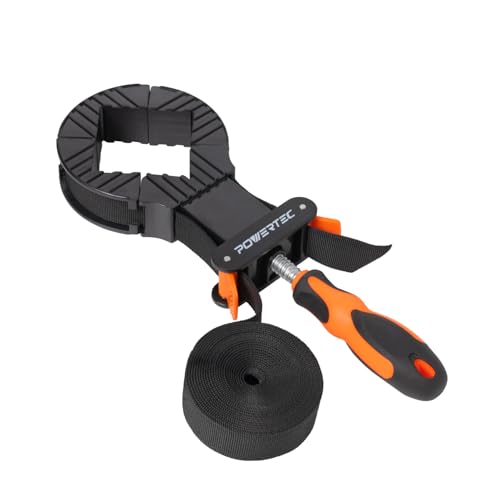
POWERTEC Strap Clamps for Woodworking, 13 ft Band Clamp (71101)
POWERTEC
- ✓14-foot nylon band
- ✓Ratchet mechanism
- ✓4 corner pads included
- ✓Handles irregular shapes
Pros
- 14-foot band handles any irregular shape that bar clamps cannot reach
- Ratchet mechanism generates significant clamping force with easy tightening
- 4 corner pads direct pressure at corner joints — good for picture frames and boxes
- Works on hexagonal, round, and odd-shaped assemblies
Cons
- Cannot apply pressure at a specific point along a panel — band distributes pressure around the perimeter
- Not suitable for wide panel glue-ups — designed for frame and irregular shapes
Best band clamp for irregular shapes. Essential for picture frames, round tabletops, and any project where bar clamps cannot reach the joint. Not a substitute for bar or pipe clamps on standard rectangular panels.

JORGENSEN 8072 Cabinet Master 72-Inch 90-Degree Parallel Jaw Bar Clamp
Jorgensen
- ✓72-inch jaw spread for full tabletops
- ✓90-degree parallel jaw alignment — no rocking
- ✓Large plastic jaws distribute pressure over a wide area
- ✓Built-in clamp stand for one-handed use
Pros
- 72-inch spread handles full-size tabletops and door panels in a single clamp
- Parallel jaw alignment stays at 90 degrees to the bar — eliminates the rocking that causes bowing in wide panels
- Built-in stand keeps the clamp stable on the bench during setup without an assistant
- Large plastic jaw faces distribute pressure over a wide area, reducing the need for cauls
Cons
- Lower maximum clamping force than the Bessey K Body REVO
- Long 72-inch bar is unwieldy to store and transport
Best large-panel clamp. The 72-inch spread and stable base solve the specific problem of clamping full tabletops without a second pair of hands. For solo woodworkers gluing up wide panels, this is the clamp to reach for.
Uneven clamp pressure is why so many glued-up panels come out of the clamps bowed instead of flat.
Gluing up a tabletop or cabinet panel from narrower boards depends entirely on the panel clamps holding everything under even, parallel force while the glue cures. Angled jaws are usually the culprit when boards buckle mid glue-up.
That's why the Bessey KR3.550 K Body REVO earns the top spot here, at $149.99 for a two-pack. Its parallel jaw design keeps full contact across the jaw width and delivers 1,700 lbs of clamping force, well above most bar clamps in this category.
For wider glue-ups, pipe clamps such as the PONY 50 fixture remain the most economical way to span a six-foot tabletop, at $19.99 with pipe sold separately. The Bessey BPC-H34 H-style clamp applies pressure from both sides at once to prevent bow without extra cauls, at $34.99.
Budget buyers can get functional results from the TEKTON ratchet clamp at $19.99, provided cauls are used to offset its jaw angle.
Why Panel Glue-Ups Are Challenging
Solid wood panels — tabletops, cabinet sides, drawer fronts — are typically glued up from multiple narrower boards because wide solid lumber is expensive, prone to warping, and difficult to find. Gluing up narrow boards produces a dimensionally stable panel at lower cost, but the glue-up process introduces specific challenges:
Panel buckling: if clamp pressure is not uniform across the full panel, the boards can bow upward or downward. This wastes material (you must plane off the bow later) and can break glue joints in severe cases.
Panel racking: if boards are not perfectly aligned edge-to-edge, the top and bottom surfaces are not flush. The glue joint works but the surface needs extensive flattening.
Glue open time: with multiple board edges to coat, standard PVA open time (5–10 minutes) runs out before all clamps are positioned. Use extended open-time glue or work quickly.
Clamp setup with wet glue: handling slippery, glue-covered boards while positioning 6–8 clamps requires practice. Dry-fit the assembly first — no glue — to verify clamp positions and tighten sequence.
Cauls: The Essential Companion to Panel Clamps
A caul is a flat board clamped perpendicular to the glue joints, crossing the top and bottom surfaces of the panel. Cauls distribute clamping pressure evenly and keep the boards flat during cure.
Without cauls, bar clamps apply pressure at a single line (the bar position). Boards between clamps can bow. With cauls top and bottom, the pressure distributes across the full width.
For a basic caul setup:
- Cut two cauls from straight 2x4 or MDF, same length as the panel
- Wax or tape the caul face so glue squeeze-out does not stick
- Position one caul on top and one on bottom, perpendicular to the glue joints
- Clamp the cauls through the panel with F-clamps or C-clamps
- Apply your bar clamps along the length of the joint edges
This combination of cauls plus bar clamps is what professional cabinetmakers use for consistently flat panels.
Clamp Spacing for Panels
Bar clamps should be placed every 8–12 inches along the glue joints for adequate pressure distribution. Alternate clamps top and bottom to counteract panel bowing from jaw angle:
- Odd-position clamps: apply from below, pushing up
- Even-position clamps: apply from above, pushing down
Alternating counteracts the tendency of standard bar clamps to cause the panel to arc toward the clamp side. This is a standard technique that significantly reduces the need for cauls.
Checking Panel Flatness During Glue-Up
After all clamps are tightened, check the panel immediately:
- Sight across the surface from one end — visible bow or cup shows immediately
- Place a long straightedge across the width and length — gaps indicate bow
- Measure diagonal flatness with two long sticks crossed from corner to corner
If the panel is bowed: add cauls, reposition clamps, or apply counteracting pressure on the high side. Do this before the glue cures — you have 30 minutes with standard PVA at room temperature.
Number of Clamps for Panel Sizes
General guideline for panel glue-ups:
- Panels up to 12 inches wide: 4 clamps (alternating 2 top, 2 bottom)
- Panels 12–24 inches: 6–8 clamps
- Panels 24–48 inches (tabletop): 8–12 clamps plus cauls
- Panels over 4 feet (conference tables, large tops): 12+ clamps, pipe clamps preferred for span
Our editorial team researches, tests, and writes every review independently. We never accept payment for placement.