Best Flush Trim Router Bit 2026: 8 Bits for Template Routing and Laminate Trimming
Last updated: 2026-08-21 · By NicheHive Editorial
This article contains affiliate links. If you purchase through these links, we may earn a commission at no extra cost to you. As an Amazon Associate, NicheHive earns from qualifying purchases. See our full disclosure.
A flush trim bit with a bearing guide follows templates and trims laminate flush to edges. We tested 8 flush trim router bits on cut quality, bearing smoothness, shank options, and performance in hardwood and laminate trimming.
Our Top Picks
- #1Freud 50-102 1/2-Inch Top Bearing Flush Trim Bit
- #2Freud 50-509 3/4-Inch Top & Bottom Bearing Flush Trim Bit
- #3Bosch 85266MC 1/2-Inch x 1-Inch Carbide-Tipped Flush Trim Router Bit
- #4Amana Tool MR0102 Miniature Flush Trim Bit
- #5Yonico 14121 Solid Carbide Flush Trim Router Bit, Spiral Up-Cut
- #6Freud 50-122 1-1/8-Inch Top Bearing Flush Trim Bit
- #7MLCS 8810 Flush and Pattern Trim Router Bit Set, 5-Piece
- #8Freud 34-132 1-Inch Radius Rounding Over Bit

Freud 50-102 1/2-Inch Top Bearing Flush Trim Bit
Freud
- ✓Top-mounted bearing
- ✓1/2-inch cutting length
- ✓1/4-inch shank
- ✓Carbide-tipped
Pros
- Freud's TiCo carbide formulation stays sharp longer than standard carbide
- Top-mounted bearing for pattern routing with template on top of the workpiece
- Smooth bearing reduces burning and ensures consistent cut depth
- The most widely recommended flush trim bit for woodworking template work
Cons
- 1/4-inch shank only -- cannot use in large router table setups requiring 1/2-inch shank
- 1/2-inch cutting length may not reach through very thick stock
Best overall flush trim router bit. Freud 50-102 is the reference recommendation for template routing. TiCo carbide, smooth bearing, and Freud's consistent manufacturing produce clean, accurate trim cuts in hardwood templates.
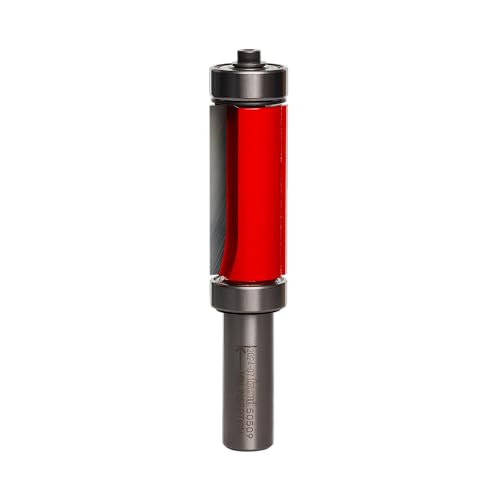
Freud 50-509 3/4-Inch Top & Bottom Bearing Flush Trim Bit
Freud
- ✓Top and bottom bearings
- ✓1-5/8-inch carbide height
- ✓1/2-inch shank
- ✓TiCo Hi-Density carbide
Pros
- Top and bottom bearings allow routing with the template above or below the workpiece without changing bits
- Tall carbide height handles thick stock in a single pass
- Freud's TiCo carbide formulation stays sharp longer than standard carbide
- 1/2-inch shank for use in full-size router table setups
Cons
- Higher price than single-bearing bits
- More weight from double bearings requires slightly more care at high speed
Best double-bearing flush trim bit. The double-bearing design eliminates the need to flip the workpiece or template when routing from different sides. For production template routing, one bit handles all configurations. Freud's TiCo carbide and consistent manufacturing keep the cut clean at both bearing positions.

Bosch 85266MC 1/2-Inch x 1-Inch Carbide-Tipped Flush Trim Router Bit
Bosch
- ✓Micro-grain carbide
- ✓Top bearing
- ✓1-inch cutting length
- ✓1/4-inch shank
Pros
- Micro-grain carbide is harder than standard carbide -- better edge retention
- 1-inch cutting length handles typical furniture parts and template work
- Bosch quality control produces consistent carbide geometry
- Priced below Freud for comparable carbide quality
Cons
- 1/4-inch shank limits to smaller router setups
- 1-inch length insufficient for very thick stock
Best mid-range flush trim bit. The Bosch 85266MC delivers Freud-level carbide quality at a lower price. For woodworkers who need a reliable flush trim bit without the premium price, this is the correct middle choice.

Amana Tool MR0102 Miniature Flush Trim Bit
Amana Tool
- ✓3/16-inch cutting diameter
- ✓Miniature ball-bearing guide
- ✓1/4-inch shank
- ✓Carbide-tipped
Pros
- Miniature bearing lets it follow tight-radius templates that a standard 1/2-inch bit cannot reach into
- Small ball bearing reduces burn marks compared to brass pilot bits on delicate templates
- 1/4-inch shank fits any handheld router or trim router
- Amana Tool carbide holds an edge well on inlay and small-pattern work
Cons
- 3/16-inch cutting diameter only -- not suited to trimming thick stock
- Short 7/16-inch cutting length limits it to thin templates and inlay work
Best compact flush trim bit for tight-radius template work. When a project needs to follow a small curve or trim a thin inlay piece that a full-size flush trim bit can't reach, the Amana MR0102's miniature bearing and small diameter get into spaces standard bits can't.

Yonico 14121 Solid Carbide Flush Trim Router Bit, Spiral Up-Cut
Yonico
- ✓Spiral up-cut geometry
- ✓Ball-bearing guide
- ✓Solid carbide
- ✓Shear-cut action
Pros
- Spiral geometry produces a shearing cut rather than a chopping cut -- significantly smoother surface
- Solid carbide (not just carbide tips) for maximum hardness and edge retention
- Shear cut dramatically reduces tearout in difficult grain directions
- The professional choice for fine furniture template routing where surface quality is critical
Cons
- Solid carbide is more brittle -- requires careful handling
- 1/4-inch shank and diameter -- not for heavy template stock removal
Best spiral flush trim bit for fine woodworking. The Yonico spiral up-cut bit produces a measurably smoother cut than any straight-flute flush trim bit. Justified for fine furniture work where the routed edge will be visible in the finished piece.

Freud 50-122 1-1/8-Inch Top Bearing Flush Trim Bit
Freud
- ✓Top bearing pattern bit
- ✓1-1/2-inch carbide height
- ✓1/2-inch shank
- ✓For template routing
Pros
- Tall carbide height handles thick template routing in full furniture-part thickness stock
- 1/2-inch shank stability for high-speed router table work
- Freud's TiCo carbide and consistent manufacturing ensure clean bearing-guided cuts
- The correct bit for routing full-thickness furniture parts against a template
Cons
- Higher price than smaller-diameter flush trim bits
- Tall cutting height makes it inappropriate for shallow cuts -- too much cutter exposed
Best pattern routing bit. For routing chair legs, curved rails, and thick furniture parts against a template where cutting depth equals full part thickness, the Freud 50-122's tall carbide height and 1/2-inch shank are the correct specification.

MLCS 8810 Flush and Pattern Trim Router Bit Set, 5-Piece
MLCS
- ✓5-piece set of flush trim and pattern bits
- ✓Multiple cutting lengths and diameters
- ✓Enclosed ball-bearing guides
- ✓Carbide-tipped
Pros
- Set covers small, medium, and large flush trim sizes in one purchase
- Multiple cutting lengths handle different stock thicknesses and template types
- Complete setup for all basic flush trim and pattern routing scenarios
- Lower cost per bit than buying five bits individually from premium brands
Cons
- Lower carbide quality than Freud or Whiteside individual bits
- Shank sizes vary by bit in the set -- check each before buying a matching collet
Best flush trim bit set for new woodworkers. The MLCS 5-piece set provides multiple diameters and cutting lengths in a single purchase. For woodworkers setting up a first router kit who do not yet know which sizes they will use most, the set covers all bases.

Freud 34-132 1-Inch Radius Rounding Over Bit
Freud
- ✓1-inch radius roundover
- ✓Bottom bearing
- ✓Quadra-Cut 4-cutter design
- ✓Produces a chamfered nose profile
Pros
- Bearing-guided roundover works on both straight and curved edges identically
- Quadra-Cut design shears cross-grain fibers before they can tear out, for a flawless finish
- Works after the flush trim bit completes the template routing
- Freud quality produces a consistent, smooth arc
Cons
- Not a flush trim bit -- a complementary edge profile bit
- 1-inch radius creates a large roundover -- choose a smaller radius bit for delicate profiles
Best bearing-guided roundover for use after flush trim routing. Template routing with a flush trim bit creates a sharp-edged part. Adding a bearing-guided roundover softens the edge without needing to set up a fence. The combination of flush trim then roundover is the core of template-based woodworking.
Cut a template out on the bandsaw and it's close, but close is not the same as exact. Getting the workpiece to match that template edge for edge takes a different tool entirely.
That's the job of a flush trim router bit: a bearing rides the template while the carbide cutter trims the workpiece flush to it, over and over, identically.
We tested eight bits, and the bearing's smoothness turned out to matter as much as the carbide itself.
The Freud 50-102 1/2-Inch Top Bearing Flush Trim Bit, at $29.99, took best overall. Its TiCo carbide holds an edge longer than standard carbide, and the smooth top bearing tracks a template without the burning or wandering that cheaper bearings produce.
How a Flush Trim Router Bit Works
A flush trim bit has a cutting flute (the carbide cutter) and a bearing guide. The bearing rolls along the edge of a template or pattern while the carbide cutter trims the workpiece to match exactly.
Template above (top bearing bit): the template is fastened to the top of the workpiece. The bearing rolls along the top of the template. The bit cuts upward through the workpiece material.
Template below (bottom bearing bit): the template is fastened to the bottom of the workpiece. The bearing rolls along the bottom template edge. The bit cuts downward through the workpiece material. This is the standard setup when the router is handheld and the template is placed on a router mat.
The most versatile setup for most woodworking is a double-bearing bit (like the Freud 50-509) that allows either template placement without changing bits.
Template Materials
Templates can be made from:
MDF: the most common template material. Easy to cut and shape, extremely flat, takes pencil lines well. 1/4-inch and 3/8-inch MDF are the most practical thicknesses.
Plywood (Baltic birch): more durable than MDF, resists chipping at template edges. Good for templates that will be used frequently.
Acrylic or polycarbonate: clear templates allow seeing the workpiece layout through the template. Useful for furniture parts where grain direction matters.
Applications in Woodworking
Pattern routing furniture parts: cut a wooden template of a chair leg, curved rail, or shaped apron. Rough-cut the workpiece oversized on the bandsaw, then use the template and flush trim bit on the router table to produce an exact duplicate.
Trimming laminate countertops: flush trim the plastic laminate (Formica) flush to the substrate edge after contact cement bonding.
Trimming edge banding: solid wood edge banding applied to plywood is trimmed flush with a handheld router and flush trim bit.
Copying existing parts: place an existing part as the template and use the flush trim bit to produce exact duplicates from new stock.
Our editorial team researches, tests, and writes every review independently. We never accept payment for placement.