Best Fast Drying Wood Glue 2026: 8 Quick-Set Glues for Woodworking
Last updated: 2026-08-21 · By NicheHive Editorial
This article contains affiliate links. If you purchase through these links, we may earn a commission at no extra cost to you. As an Amazon Associate, NicheHive earns from qualifying purchases. See our full disclosure.
Fast-setting wood glues reduce clamp time from 60 minutes to as little as 15 minutes. We tested 8 quick-set PVA and polyurethane glues on setting time, final bond strength, creep resistance, and sanding behavior.
Our Top Picks
- #1Titebond III Ultimate Wood Glue, 16-Ounces
- #2Titebond Quick & Thick Multi-Surface Glue, 8 oz
- #3Titebond Original Wood Glue, 8 oz
- #4Gorilla Wood Glue, Fast Clamp, 8 oz
- #5Elmer's E7300 Carpenter's Wood Glue Max, 8 oz
- #6DAP RapidFuse Wood Adhesive, 4 oz
- #7Titebond Liquid Hide Glue, 8-Ounces
- #8Gorilla Super Glue Gel, 15 Gram

Titebond III Ultimate Wood Glue, 16-Ounces
Titebond
- ✓Waterproof — passes ANSI/HPVA Type I test
- ✓25-minute clamp time at 70°F
- ✓Sands cleanly without clogging
- ✓FDA approved for indirect food contact
Pros
- 25-minute clamp time is significantly faster than standard PVA at 60 minutes
- Waterproof bond tested to ANSI Type I standard — safe for outdoor furniture
- Sands cleanly without gumming up sandpaper — critical for glue line work
- FDA approved — safe for cutting boards and wooden utensils after cure
Cons
- Slower setting time than Titebond Quick & Thick or CA glues
- Slightly higher price than standard PVA glues
Best overall fast-drying wood glue. The combination of 25-minute clamp time, waterproofing, and clean sanding behavior makes Titebond III the most practical all-around wood glue for serious woodworkers.

Titebond Quick & Thick Multi-Surface Glue, 8 oz
Titebond
- ✓15-minute clamp time
- ✓Thick formula — minimal drip
- ✓Works on porous and semi-porous surfaces
- ✓Paintable and sandable
Pros
- 15-minute clamp time is the fastest in the Titebond lineup for PVA-type glues
- Thick formula minimizes drip on vertical joint faces and overhead applications
- Works on porous ceramics, leather, and fabric in addition to wood
- Paintable and sandable after cure
Cons
- Not waterproof — interior use only
- Thick formula does not wick into very tight joints as readily as thin PVA
Best quick-clamp PVA. At 15 minutes, this is the fastest standard PVA-type wood glue available. The thick formula is specifically useful for vertical joint faces in face frame and cabinet assembly.
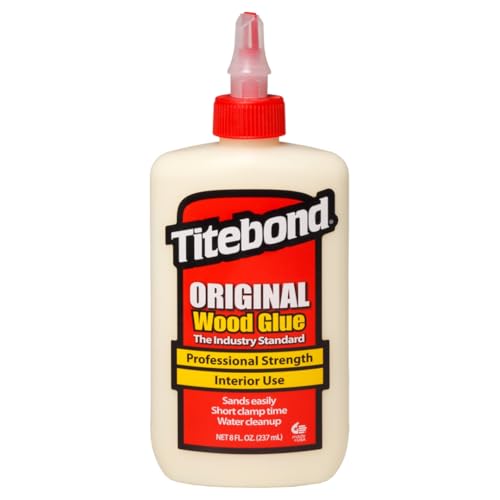
Titebond Original Wood Glue, 8 oz
Titebond
- ✓30-minute clamp time
- ✓Sands and planes cleanly
- ✓Strong creep resistance
- ✓ANSI/HPVA Type II water resistance
Pros
- Lowest price Titebond option with excellent bond strength
- 30-minute clamp time still faster than many competitor PVA glues
- Excellent sanding and planing behavior — does not gum up blades
- Industry standard for interior furniture and cabinet work for decades
Cons
- Not waterproof — ANSI Type II (water resistant, not waterproof)
- 30 minutes clamp time slower than Quick & Thick or Titebond III
Best budget wood glue. Titebond Original has been the shop standard for interior woodworking for a generation. When waterproofing is not required, this is the best value per dollar.

Gorilla Wood Glue, Fast Clamp, 8 oz
Gorilla
- ✓20-30 minute clamp time
- ✓Water-resistant
- ✓Natural color after cure
- ✓Works on hardwood, softwood, natural wood composites
Pros
- Natural (slightly tan) color after cure — less visible in light-colored woods than white PVA
- Water-resistant bond handles moderate humidity environments
- Strong final bond — exceeds ANSI Type II requirements
- Widely available in hardware stores — easy to restock
Cons
- Not as widely used in professional shops as Titebond — less community support
- Slightly shorter open time than Titebond III in warm conditions
Best Gorilla brand wood glue. Comparable performance to Titebond II with a natural color that blends better into light-colored wood. Water-resistant and easy to find at any hardware store.

Elmer's E7300 Carpenter's Wood Glue Max, 8 oz
Elmer's
- ✓30-minute clamp time
- ✓Water-resistant
- ✓Interior/exterior use
- ✓Bonds stronger than wood
Pros
- Available at most grocery and drug stores — convenient for quick repairs
- Bond stronger than the wood itself when clamped properly
- Water-resistant formula handles occasional moisture
- Low price per ounce in larger containers
Cons
- Not waterproof — not suitable for continuous water contact
- Lower quality consistency than Titebond in professional evaluations
- 30-minute clamp time is average, not exceptional
Best widely-available wood glue. For home repairs and light woodworking where professional-grade Titebond is not at hand, Elmer's Carpenter's Max is reliable and available everywhere.

DAP RapidFuse Wood Adhesive, 4 oz
DAP
- ✓15-second initial set
- ✓Full cure in 1 hour
- ✓No clamp required for many applications
- ✓Water-resistant
Pros
- 15-second initial set eliminates clamping for many small repairs and assemblies
- Full 1-hour cure time still produces a strong final bond
- Water-resistant formula handles moderate exterior exposure
- Good for quick repairs where you cannot apply clamps
Cons
- 15-second set time leaves almost no repositioning time — parts must be aligned before application
- Not suitable for complex multi-joint assemblies where you need time to adjust
- Bond strength slightly lower than Titebond in tensile tests
Best ultra-fast wood adhesive. The 15-second initial set is faster than any standard PVA. For repairs and small assemblies where you cannot clamp, DAP Rapid Fuse is the right tool.

Titebond Liquid Hide Glue, 8-Ounces
Titebond
- ✓30-minute open time
- ✓Reversible with hot water or heat
- ✓Traditional furniture restoration glue
- ✓Creep-resistant
Pros
- 30-minute open time gives the most working time of any glue on this list
- Fully reversible with hot water or steam — joints can be disassembled for repair years later
- Traditional choice for instrument building and antique furniture
- Excellent creep resistance — joints do not move under sustained load
Cons
- Must be kept warm to maintain proper consistency — thickens at room temperature
- Not waterproof — not suitable for outdoor applications
- 30-minute clamp time, not faster than standard PVA
Best hide glue for instrument and restoration work. Reversibility is the key feature — antique furniture and musical instruments are repaired with hide glue so joints can be opened again without damage. The 30-minute open time handles complex assembly sequences.

Gorilla Super Glue Gel, 15 Gram
Gorilla
- ✓10-second set on wood
- ✓Gel formula — no drips
- ✓Impact-resistant formula
- ✓Cyanoacrylate adhesive
Pros
- 10-second set — the fastest setting time of any adhesive on this list
- Gel formula fills small gaps and stays put on vertical surfaces without running
- Rubber-toughened formula resists impact better than standard thin CA glue
- Widely available for quick restocking, unlike specialty woodturning CA brands
Cons
- Brittle after cure compared to PVA -- not suitable for joints subject to impact or flexing
- Cannot be used in large joints where PVA is necessary for strength
- Shorter shelf life than PVA glues once opened
Fastest-setting wood adhesive. For repairs where you cannot wait 15 to 30 minutes and the joint is not under heavy load, gel CA glue is the answer. The gel formula is more practical for wood than thin CA because it does not run into surrounding grain.
An hour of clamps sitting on a project is an hour you're not moving to the next step. For a lot of shop schedules, that wait is the actual bottleneck, not the glue itself.
Fast-drying wood glue cuts that down, in some cases to 15 minutes instead of 60.
Speed isn't the only thing that matters, though. We tested eight quick-set glues, and the fastest options aren't automatically the best overall choice.
Titebond III Ultimate Wood Glue, at $16.99, still topped the list despite not having the shortest clamp time in the group. Its full waterproof cure and creep resistance hold up better over years of use than the quicker Titebond Quick & Thick or the 15-second DAP RapidFuse, which trade some long-term durability for speed.
Clamp Time vs Full Cure Time: They Are Not the Same
All wood glues have two relevant time measurements:
Open time: how long you have to position and align parts before the glue begins to grab. Standard PVA has 5–10 minutes. Extended open time formulas give 20+ minutes.
Clamp time: how long parts must stay clamped before the glue is strong enough to handle without breaking the joint. Ranges from 15 minutes (Titebond Quick & Thick) to 60 minutes for some water-based PVA glues.
Full cure time: when the glue reaches maximum strength. Usually 24 hours for PVA glues regardless of how fast they set initially. Clamping time and full cure time are different — removing clamps after 20 minutes is fine for handling but the joint is not at full strength until the next day.
Do not cut or stress a freshly glued joint until full cure (24 hours). Many woodworkers glue up overnight precisely to avoid this wait during their working session.
Temperature Affects Set Time
Most wood glue manufacturers specify clamp times at 70°F (21°C). In a cold shop:
- Below 55°F (13°C): many PVA glues will not cure properly — the liquid may freeze inside the joint
- Below 65°F: clamp time increases significantly — add 50% to stated clamp times
- Above 80°F: open time decreases — glue grabs faster than expected, leaving less alignment time
For winter woodworking, warm the shop to at least 65°F before glue-ups, and keep glue bottles at room temperature. Cold glue in a warm shop is still cold until the joint warms up.
Joint Fit Matters More Than Brand
No wood glue compensates for a poorly fitting joint. PVA glue produces its strongest bond with a glue line thinner than 0.005 inches — the glue layer is essentially invisible in a tight joint. Gaps thicker than 1/16 inch require epoxy or polyurethane glue. The fastest-drying wood glue in the world will not hold a poorly fitted mortise or loose tenon at full strength.
Fit the joint first, then choose the glue based on the application.
Squeeze-Out Management
Glue squeeze-out at the joint line is normal and confirms full glue coverage. The question is how to remove it:
Wet method: Wipe squeeze-out with a damp cloth while still wet. Fast and easy, but pushes diluted glue into the surrounding wood grain — this diluted PVA prevents finish absorption (glue spots) when staining or finishing later.
Dry method: Let squeeze-out cure to a rubbery consistency (30–60 minutes), then peel or chisel it off. Slightly slower but does not push glue into surrounding grain. Better for stained and natural finishes.
After full cure: Scrape, chisel, or plane flush when fully cured. Most reliable but requires more tool time.
For stained or naturally finished work, the dry peel method produces the fewest finish problems.
Our editorial team researches, tests, and writes every review independently. We never accept payment for placement.