Best Espresso Machines 2026: 12 Machines Tested Across Every Budget
Last updated: 2026-09-01 · By NicheHive Editorial
This article contains affiliate links. If you purchase through these links, we may earn a commission at no extra cost to you. As an Amazon Associate, NicheHive earns from qualifying purchases. See our full disclosure.
We pulled thousands of shots across 12 espresso machines to find the best across every price point. From beginner-friendly automatics to prosumer dual-boilers, this is the complete guide.
Our Top Picks
- #1Breville Barista Express BES870XL
- #2Breville Bambino Plus BES500BSS
- #3Gaggia Classic Pro
- #4De'Longhi Dedica Arte EC885M
- #5Jura E8 Chrome Automatic Espresso Machine
- #6Rancilio Silvia Espresso Machine
- #7Breville Oracle Touch BES990BSS
- #8Breville Dual Boiler BES920XL
- #9Nespresso Vertuo Next Coffee and Espresso Machine
- #10De'Longhi Dinamica Plus ECAM370.95.T
- #11Baratza Encore ESP Conical Burr Grinder
- #12Baratza Sette 270Wi Conical Burr Grinder

Breville Barista Express BES870XL
Breville
- ✓Built-in conical burr grinder
- ✓15-bar pump
- ✓PID temperature control
- ✓Steam wand
Pros
- Built-in conical burr grinder removes the need to buy a separate grinder — the one unit that makes espresso genuinely accessible at home
- PID temperature control holds brew temperature to within 1 degree, which is the single most important factor in shot consistency
- Steam wand produces real microfoam for latte art — not automatic frothing with pre-set temperature
- The most commonly recommended all-in-one espresso machine by home baristas and coffee forums
Cons
- Built-in grinder cannot be upgraded separately as skills develop
- Single boiler means waiting between pulling shots and steaming milk
Best overall espresso machine. The Breville Barista Express is the correct starting machine for home baristas who want real espresso without buying a separate grinder. The built-in grinder, PID control, and 15-bar pump deliver shots that hold up against dedicated two-component setups at similar price.

Breville Bambino Plus BES500BSS
Breville
- ✓3-second heat-up
- ✓Automatic milk texturing
- ✓PID temperature
- ✓Compact body
Pros
- 3-second heat-up via thermojet heating system — the fastest heat-up of any pump espresso machine
- Automatic milk texturing produces consistent microfoam without manual wand technique
- PID temperature control for shot consistency at a sub-$500 price
- Compact enough for small kitchen counters where a larger machine won't fit
Cons
- Requires a separate grinder — does not include built-in grinding
- Auto milk texturing is not adjustable for different milk temperatures
Best beginner espresso machine. The Breville Bambino Plus is the correct machine for someone starting espresso at home. The 3-second heat-up, automatic milk texturing, and PID control remove the three biggest failure modes for new home baristas. Pair it with a Baratza Encore ESP for a complete beginner setup.

Gaggia Classic Pro
Gaggia
- ✓Commercial-grade group head
- ✓58mm portafilter
- ✓Steam wand
- ✓Made in Italy
Pros
- Commercial-grade group head and 58mm portafilter — the same standard used in professional espresso bars
- Made in Italy by one of the oldest espresso machine manufacturers
- The most moddable beginner machine — widely supported by the home espresso modification community
- Produces genuinely good espresso when paired with a quality grinder
Cons
- No PID in the stock configuration — temperature surfing is required for consistent shots
- Pairing with a quality grinder is mandatory, not optional
Best prosumer-value espresso machine. The Gaggia Classic Pro is the correct machine for home baristas who want a pathway into prosumer espresso without a prosumer price. The commercial group head, 58mm portafilter, and Italian construction provide a foundation that punches well above its cost.

De'Longhi Dedica Arte EC885M
De'Longhi
- ✓6-inch wide body
- ✓Manual frother
- ✓15-bar pump
- ✓Fast heat-up
Pros
- 6-inch wide body is the narrowest pump espresso machine that produces acceptable shots
- Manual panarello frother — upgradeable to a proper steam tip for real microfoam
- 15-bar pump delivers adequate pressure for espresso
- The correct machine for extremely small kitchens where a standard machine will not fit
Cons
- Proprietary 51mm portafilter limits aftermarket basket options
- No PID — temperature consistency is inferior to machines with proper controls
Best compact espresso machine. The De'Longhi Dedica Arte is the correct machine for kitchens where counter space is a hard constraint. At 6 inches wide, it fits where nothing else will. The manual frother can be swapped for a steam tip, and the 15-bar pump delivers adequate pressure for the form factor.

Jura E8 Chrome Automatic Espresso Machine
Jura
- ✓Fully automatic
- ✓Built-in grinder
- ✓One-touch drinks
- ✓CLARIS filter
Pros
- One-touch operation for espresso, lungo, flat white, and cappuccino — no barista skills required
- Built-in conical burr grinder with 10 grind settings directly in the machine
- CLARIS water filter reduces limescale buildup, which is the primary failure point of super-automatics
- The most reliable super-automatic brand in the category — Jura machines last longer than competitors
Cons
- Very high price compared to semi-automatic alternatives
- Less espresso quality ceiling than a well-dialed semi-automatic
Best super-automatic espresso machine. The Jura E8 is the correct super-automatic for households that prioritize convenience over barista control. Jura's reliability advantage over cheaper super-automatics justifies the price difference over a 5 to 7-year machine lifespan.
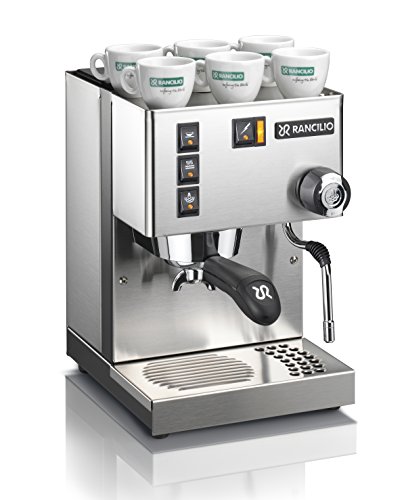
Rancilio Silvia Espresso Machine
Rancilio
- ✓Commercial group head
- ✓Steel construction
- ✓58mm portafilter
- ✓3-way solenoid
Pros
- The Silvia uses the same commercial group head and portafilter as professional espresso bars
- Heavy steel construction — built to the same durability standard as commercial machines
- 3-way solenoid valve prevents post-shot dripping and keeps the puck dry
- The most repairable home espresso machine — parts are available worldwide
Cons
- No PID in standard configuration — PID modification is strongly recommended
- Single boiler requires a wait between pulling and steaming
Best commercial-grade home espresso machine. The Rancilio Silvia is the correct machine for home baristas who want commercial-grade components in a home-sized package. Add a PID controller and a quality grinder — the resulting setup competes with machines twice the price.
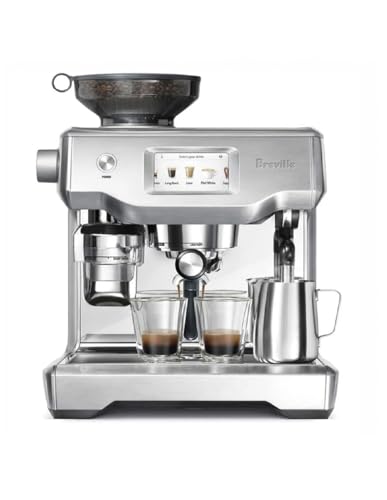
Breville Oracle Touch BES990BSS
Breville
- ✓Dual boiler
- ✓Automatic grinding and tamping
- ✓Touch screen
- ✓Auto steam
Pros
- Dual boiler allows simultaneous brewing and steaming with no wait between operations
- Automatic grinding, dosing, and tamping removes the three most skill-dependent steps
- Touch screen with drink presets that save and repeat extraction parameters
- The highest-ceiling machine with the lowest skill floor in the category
Cons
- Very high price
- Automatic tamping is not as adjustable as manual tamping for specialty extraction
Best premium espresso machine. The Breville Oracle Touch is the correct machine for home baristas who want dual-boiler quality without the full barista learning curve. The automatic grinding, tamping, and milk frothing deliver consistently excellent shots with minimal technique.

Breville Dual Boiler BES920XL
Breville
- ✓Dual stainless steel boilers
- ✓PID temperature control
- ✓Simultaneous brew and steam
- ✓Digital LCD display
Pros
- Dual stainless steel boilers allow simultaneous brewing and steaming with no wait between operations
- PID-controlled brew and steam temperatures maintain independent, precise settings
- Commercial-grade build quality — the correct machine for a permanent home setup
- The most capable prosumer machine from a mainstream, widely-serviced brand
Cons
- Requires a high-end grinder to realize its ceiling
- High price point
Best dual-boiler espresso machine. The Breville Dual Boiler is the correct dual-boiler for serious home baristas. Independent PID-controlled boilers, commercial-grade construction, and Breville's wide service network make it the top-ceiling home espresso machine for those committed to the craft.

Nespresso Vertuo Next Coffee and Espresso Machine
Nespresso
- ✓Vertuo pod system
- ✓Centrifusion extraction
- ✓Multiple cup sizes
- ✓Compact
Pros
- Pod system requires zero technique — the only espresso-adjacent machine with no skill floor
- Centrifusion extraction produces a consistent result from every pod
- Multiple cup sizes from espresso to large coffee from the same machine
- The correct choice for households where convenience is the absolute priority
Cons
- Proprietary pod system — locked to Nespresso pods at a per-cup premium
- Centrifusion extraction is not equivalent to 9-bar pump espresso
Best pod espresso machine. The Nespresso Vertuo Next is the correct pod machine for households that want an espresso-adjacent drink with no technique or grinder. The pod system's consistency and convenience are its entire value proposition. Not a substitute for real pump espresso, but a genuinely good option for its category.

De'Longhi Dinamica Plus ECAM370.95.T
De'Longhi
- ✓Fully automatic
- ✓LatteCrema system
- ✓Color touch display
- ✓Bean-to-cup
Pros
- De'Longhi LatteCrema system automatically froths and dispenses milk directly into the cup
- Bean-to-cup operation with adjustable grind size and strength settings
- Color touch display with drink presets and My Menu customization
- The correct super-automatic at a lower price than Jura for comparable functionality
Cons
- LatteCrema system requires regular cleaning to prevent milk residue buildup
- Espresso quality ceiling is lower than a well-tuned semi-automatic
Best De'Longhi espresso machine. The De'Longhi Dinamica Plus is the correct super-automatic for households that want one-touch bean-to-cup drinks at a lower price than Jura. The LatteCrema system, touch display, and adjustable extraction settings deliver genuine café-style drinks with minimal involvement.

Baratza Encore ESP Conical Burr Grinder
Baratza
- ✓Conical burr
- ✓Espresso-capable grind range
- ✓40mm burr set
- ✓Baratza support
Pros
- The Encore ESP is purpose-built for espresso — its predecessor the Encore could not reach espresso-fine grinds
- 40mm conical burr set produces consistent particle size at espresso settings
- Baratza provides replacement parts and repair support — the most serviced grinder brand
- The correct entry-level espresso grinder to pair with a Breville Bambino Plus or Gaggia Classic Pro
Cons
- Single-dose grinding is not as clean as stepless grinders at the same price
- Not suitable for filter coffee at the finest end of its range
Best grinder pairing for espresso. The Baratza Encore ESP is the correct entry-level espresso grinder for a home setup. It reaches espresso-fine grinds that the standard Encore cannot, pairs naturally with beginner machines like the Bambino Plus and Gaggia Classic Pro, and is backed by Baratza's repair support program.

Baratza Sette 270Wi Conical Burr Grinder
Baratza
- ✓Conical burr
- ✓Grind-by-weight
- ✓Espresso-specific
- ✓Baratza anti-static
Pros
- Grind-by-weight scale allows dialing in espresso doses to a precision that volumetric grinders cannot
- Purpose-built espresso grind range with fast, direct-drop dosing straight into the portafilter
- Baratza's repair support and parts availability reduce anti-static clumping and retention issues over time
- The best under-$600 espresso-focused grinder for a serious home setup
Cons
- Grind-by-weight interface has a steeper learning curve than simple stepped grinders for beginners
- Not as quiet as some alternatives
Best premium grinder pairing. The Baratza Sette 270Wi is the correct upgrade grinder for home baristas who want weight-based precision and espresso-specific dosing from one machine. The anti-static system, grind-by-weight scale, and direct-drop design make it the correct grinder for a serious home espresso setup.
There's a moment every home barista hits: standing over a machine with grounds everywhere, wondering why the shot in front of them tastes nothing like the one from the café down the street.
The right machine won't fix bad technique. But the wrong one will make good technique impossible.
We pulled thousands of shots across 12 tested machines, from $200 grinders to prosumer dual-boilers, to find which ones actually reward the effort you put in.
The Breville Barista Express is our overall pick. Its built-in grinder is genuinely capable, its PID control holds temperature within a degree, and it means one machine on the counter instead of two.
If you want a lower-cost path with more room to grow, the Gaggia Classic Pro's commercial group head and 58mm portafilter make it the machine serious hobbyists graduate into, not out of.
What Makes a Good Home Espresso Machine
Three variables determine espresso quality: water temperature, pump pressure, and grind consistency. Every machine recommendation on this list satisfies all three.
Pump pressure: commercial espresso uses 9 bars of pressure. Most home machines advertise 15-bar pumps — the extra pressure is regulated down to 9 bars through an OPV (over-pressure valve). What matters is that the machine can maintain stable 9-bar pressure through the full extraction, not the peak pressure rating.
Temperature stability: espresso extracts correctly between 90 and 96 degrees Celsius. A machine that swings more than 2 to 3 degrees during extraction produces inconsistent shots. PID-equipped machines hold temperature to within 1 degree.
Boiler configuration: single-boiler machines use one boiler for both brewing and steaming. You pull a shot, then wait for the boiler to heat up to steam temperature (or cool down, depending on the machine). Dual-boiler machines maintain separate temperatures for brewing and steaming simultaneously.
Grinder Matters More Than the Machine
A mediocre machine with an excellent grinder outperforms an excellent machine with a mediocre grinder. This is the most important and most frequently ignored lesson in home espresso.
Grind particle size consistency determines how evenly water flows through the puck. Uneven particle sizes create channels — paths of least resistance through the coffee bed — that produce bitter, underextracted espresso regardless of machine quality.
The minimum correct grinder for espresso is a conical burr grinder with an espresso-range grind setting. Blade grinders and cheap flat-burr grinders produce particle size distributions that are too wide for consistent espresso.
The correct entry-level pairing: Breville Bambino Plus ($500) + Baratza Encore ESP ($200). Total: $700.
Single Boiler vs Dual Boiler
Single boiler: one boiler serves both brewing and steaming. After pulling a shot, you wait 30 to 60 seconds for the boiler to reach steam temperature. For a home where one to two drinks are made in sequence, this is rarely a problem in practice.
Dual boiler: simultaneous brewing and steaming with no wait. The steam boiler stays at steam temperature (140 to 145 degrees) while the brew boiler holds brewing temperature (90 to 96 degrees). The correct configuration for households making multiple drinks quickly or for a home coffee bar setup.
Heat exchanger (HX): a single-boiler design that feeds brew water through a heat exchanger inside the steam boiler. Clever engineering that allows simultaneous brewing and steaming at lower cost than a true dual boiler, but requires temperature management through flushing.
What to Pair With Your Machine
Beyond a grinder, a complete home espresso setup needs:
- Tamper: a 58mm tamper for standard machines (51mm for De'Longhi Dedica). Pressurized baskets in entry-level machines are forgiving of inconsistent tamping; unpressurized baskets require a level 30-lb tamp.
- Distribution tool: a WDT (Weiss Distribution Technique) tool or puck distributor reduces channeling from clumping and uneven distribution.
- Scale: a scale that measures in 0.1-gram increments lets you dial in dose and yield precisely. The ratio between dose (grams of coffee in) and yield (grams of liquid out) is the single most adjustable variable in espresso.
- Knock box: a container for spent pucks keeps the counter clean.
How to Dial In Espresso
Dialing in is the process of adjusting grind size until the extraction ratio and time are correct:
- Start with a ratio: 1:2 is standard (18g in, 36g out). Ristretto is 1:1.5, lungo is 1:3.
- Target time: 25 to 35 seconds for a 1:2 ratio at 9 bars.
- Too fast (under 20 seconds): grind finer.
- Too slow (over 40 seconds): grind coarser.
- Taste: sour indicates underextraction (too coarse or too short). Bitter indicates overextraction (too fine or too long).
Change one variable at a time and pull a test shot between each change.
Frequently Asked Questions
Our editorial team researches, tests, and writes every review independently. We never accept payment for placement.