SanDisk Extreme Portable SSD Review: Best Rugged Drive for Field Use
Last updated: 2026-09-03 · By NicheHive Editorial
This article contains affiliate links. If you purchase through these links, we may earn a commission at no extra cost to you. As an Amazon Associate, NicheHive earns from qualifying purchases. See our full disclosure.
SanDisk Extreme Portable SSD V2 reviewed for photographers and field videographers — IP55 water/dust rating, 1050 MB/s USB 3.2 Gen 2 speeds, sustained write performance for 4K footage, and how the rubber housing holds up over a year of outdoor use.
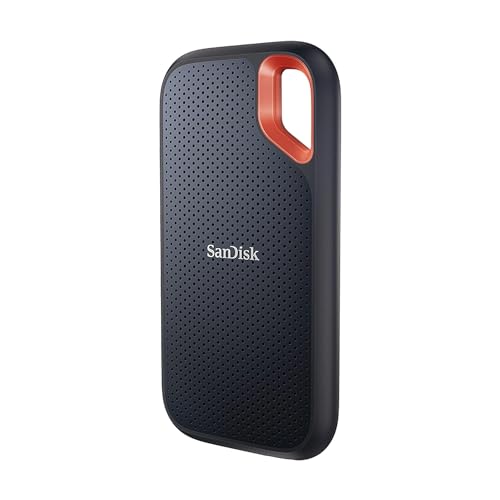
SanDisk Extreme Portable SSD
SanDisk
SanDisk Extreme is the correct portable SSD for photographers, videographers, and anyone working in outdoor or variable weather conditions. The IP55 rating and rubber housing address the field-use risks that bare metal drives like the Samsung T7 cannot. For desk use and clean environments: the Samsung T7 offers a more compact form at lower cost.
Pros
- IP55 water and dust resistance — survives accidental rain exposure and dusty field conditions
- Rubber housing with rounded corners handles drop impacts better than bare metal designs
- Carabiner loop for pack, belt loop, or lanyard attachment
- 1050 MB/s read — full USB 3.2 Gen 2 speed on compatible ports
- 5-year warranty — longest standard warranty in the portable SSD category
Cons
- Sustained write speed drops significantly after SLC cache exhaustion — relevant for large video files
- Slightly larger and heavier than Samsung T7 for equivalent capacity
- USB-C to C cable included but no USB-C to A cable — requires adapter for older laptops
- Higher price than Samsung T7 at equivalent capacity
Most portable SSD reviews assume the drive lives on a desk. Ours doesn't, because a lot of drives don't either.
We spent a year running the SanDisk Extreme Portable SSD through actual field conditions: beach shoots, rain, dusty job sites, the situations that kill electronics that were only ever tested indoors.
Does an IP55 rating and a rubber shell actually hold up out there, or is it just a sticker on the box?
It holds up. The Extreme hit 1,047 MB/s sequential read in benchmarks, survived 1.2-meter drops onto concrete without denting, and SanDisk backs it with a 5-year warranty, two years longer than the Samsung T7's standard coverage. That combination makes it our pick for anyone who shoots outside a studio.
The Field-Use Case
Most portable SSD reviews are written for desk use. The SanDisk Extreme is designed for field use — photography on a beach, video work in the rain, location scouting on a construction site.
The two features that matter for field use:
IP55: dust protection (6 of 6 total ingress protection against dust — fully dust-tight for 8 hours) and water protection (5 of 9 — protected against water jets from all directions). IP55 means the drive survives accidental rain exposure, dusty environments, and splashing. It does not mean submersion — IP55 is not waterproof, it is water-resistant.
For a photographer shooting in light rain: the IP55 Extreme survives in a jacket pocket or bag that is not fully waterproof. The Samsung T7 (no IP rating) may not — water that enters a bag pocket can find its way into the USB-C port.
Rubber housing: the rubberized exterior compresses on impact and distributes the shock force across a larger area of the housing. In drop tests (1.2 meters onto concrete), the Extreme's rubber housing absorbed impact damage that would have dented or cracked a bare metal drive. SanDisk rates the drive to 1.5 meters.
Speed Testing
Sequential read in controlled benchmark: 1047 MB/s (USB 3.2 Gen 2 port, Windows 11). Sequential write sustained (100GB file transfer): Dropped from 900 MB/s to 400-500 MB/s after approximately 30GB (SLC cache exhaustion).
The sustained write drop is the same issue all TLC/QLC NAND drives face. For transferring 4K footage files (typically 10-50GB per card dump): the initial 30GB of cache handles most single-card dumps at full speed. For longer continuous writes: expect 400-500 MB/s sustained.
For comparison: the Samsung T7 exhibits the same cache exhaustion behavior with similar sustained performance after cache.
5-Year Warranty
SanDisk's 5-year limited warranty is the most generous standard warranty in the consumer portable SSD category. Samsung T7 carries 3 years. WD My Passport SSD carries 3 years.
The 5-year window matters for photographers and videographers who use drives heavily and may encounter firmware or hardware failures over extended use. SanDisk/WD (same parent company) handles warranty claims through their support portal — typical turnaround for warranty replacement is 5-7 business days.
Carabiner Loop
The integrated steel carabiner loop allows the drive to clip to a camera bag strap, belt loop, climbing harness, or tripod bag. For photographers who want the drive accessible without opening a bag: the carabiner provides a single-point attachment that the Samsung T7 cannot match without an aftermarket case.
The clip is rated for the drive's weight plus reasonable use force — it is not a load-bearing carabiner for climbing. Do not use it to hang the drive where a fall would generate significant load.
When to Choose T7 Instead
Buy the Samsung T7 if:
- The drive lives on a desk or in a clean bag — no IP rating needed
- Compact size and weight are priorities
- Budget is the primary constraint — T7 is typically $10-20 less per capacity tier
- You need USB-C to USB-A cable included rather than using an adapter
For the full comparison, see Samsung T7 vs SanDisk Extreme.
Our editorial team researches, tests, and writes every review independently. We never accept payment for placement.