KitchenAid vs. Bosch Stand Mixer: Which One Should You Buy?
Last updated: 2026-09-02 · By NicheHive Editorial
This article contains affiliate links. If you purchase through these links, we may earn a commission at no extra cost to you. As an Amazon Associate, NicheHive earns from qualifying purchases. See our full disclosure.
KitchenAid Artisan 5-quart versus Bosch Universal Plus 6.5-quart stand mixer comparison across motor power, bowl capacity, bread performance, attachment ecosystem, and design — with a clear recommendation based on baking type.
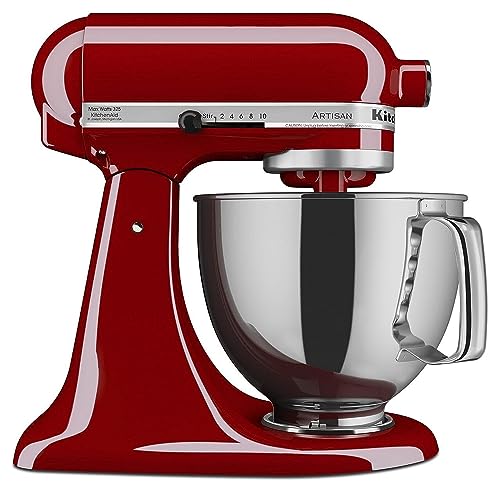
KitchenAid Artisan 5-Quart Tilt-Head Stand Mixer
KitchenAid
- ✓325W continuous-rated motor with 10-speed control
- ✓5-quart stainless bowl, single-handle design
- ✓Tilt-head with flat beater, wire whisk, and dough hook included
- ✓Compatible with 12+ official KitchenAid hub attachments
- ✓35+ color options
Pros
- Largest stand mixer attachment ecosystem available — pasta rollers, meat grinder, ice cream bowl, and more share one hub
- Tilt-head design gives easier bowl access and faster attachment changes than the Bosch's fixed head
- 5-year limited warranty — the strongest in the household stand mixer category
- 35+ color options for kitchen matching, versus Bosch's white and red
- Planetary mixing action keeps close bowl clearance for thorough incorporation with minimal scraping
Cons
- 325W motor strains on stiff or high-hydration bread dough compared to the Bosch's 500W
- 5-quart bowl caps out at roughly 3 cups of flour per bread batch — less than half the Bosch's capacity
- Motor runs warm during sustained kneading sessions past 3 to 5 minutes
- $350 to $450 retail is $50 to $100 more than the Bosch at equivalent quality tiers

Bosch Universal Plus MUM6N10UC 6.5-Quart Stand Mixer
Bosch
- ✓500W motor with bowl-drive (motor-in-base) mechanism
- ✓6.5-quart stainless bowl — holds 8 cups of flour per batch
- ✓Spiral dough hook, large balloon whisk, cookie paddles, and spatula attachment included
- ✓Optional pasta, blender, and mincer accessories via dedicated port
- ✓Available in white or red
Pros
- 500W bowl-drive motor handles 8 cups of flour continuously for 10+ minutes without overheating
- 6.5-quart bowl holds roughly four standard loaves per batch — more than double the KitchenAid Artisan's capacity
- Bowl-drive geometry keeps dough in contact with a stationary hook, eliminating the dough-climbing problem common to head-drive mixers
- Includes more standard attachments than the Artisan — cookie paddles and a spatula attachment beyond the usual beater, hook, and whisk
- $300 to $400 retail — typically less expensive than the KitchenAid Artisan despite more power and capacity
Cons
- Bosch's attachment ecosystem is much smaller than KitchenAid's — no equivalent to the pasta roller, meat grinder, or ice cream bowl breadth
- 1-year limited warranty versus KitchenAid's 5-year coverage
- Colors limited to white and red only
- Covered bowl design makes adding ingredients mid-mix less intuitive than a tilt-head
- Less brand recognition and service network availability in North America
Two stand mixers, two completely different philosophies. One question decides between them: are you baking cakes and cookies, or kneading bread on a regular basis?
The KitchenAid Artisan answers the first question well. A 325W motor, a 5-quart bowl, a tilt-head design, backed by 12-plus attachments and 35-plus colors.
The Bosch Universal Plus answers the second. Its 500W bowl-drive motor and 6.5-quart bowl handle 8 cups of flour in a single batch, more than double the Artisan's bread capacity.
Neither wins across the board. The comparison below breaks down the full spec sheet so the tradeoffs, attachment variety against raw kneading capacity, are clear before you spend $300 or more.
The One-Line Summary
KitchenAid Artisan for cake and cookie bakers who want attachments and design options. Bosch Universal Plus for bread bakers who want maximum motor power at any price.
Specifications Head-to-Head
| Spec | KitchenAid Artisan | Bosch Universal Plus |
|---|---|---|
| Motor | 325W | 500W |
| Bowl | 5-quart stainless | 6.5-quart stainless |
| Mechanism | Tilt-head, attachment rotates | Bowl-drive, bowl rotates |
| Max flour (bread) | 3 cups | 8 cups |
| Included attachments | Flat beater, dough hook, whisk | Dough hook, whisk, cookie paddles, spatula |
| Attachment ecosystem | 12+ KitchenAid attachments | Limited Bosch accessories |
| Colors | 35+ | White, red |
| Head design | Tilt-head | Fixed head, lever bowl lift |
| Built | Greenville, Ohio, USA | Germany |
| Warranty | 5-year limited | 1-year limited |
Motor and Bread Performance
This is where the two machines diverge completely. The Bosch Universal Plus carries a 500W high-torque bowl-drive motor — among the highest-torque motors in the household stand mixer category. The KitchenAid Artisan runs at 325W. Both brands rate differently (KitchenAid rates peak mechanical output; Bosch rates input power), but the practical difference in bread dough kneading is not obscured by the rating methodology: the Bosch handles 8 cups of flour per batch continuously for 10+ minutes. The KitchenAid handles 3 cups and benefits from rest intervals after 3 to 5 minutes of continuous kneading.
For cake batter, cookie dough, frosting, and whipped cream: both machines perform identically well. Neither task is particularly demanding of motor wattage — a 250W mixer handles these tasks adequately. The wattage difference only manifests in bread dough and other stiff, heavy mixing tasks.
The Bosch bowl-drive adds a second advantage for bread: the bowl rotates around a stationary central dough hook, which is more efficient for large dough masses (the dough's own weight keeps it in contact with the hook) and eliminates dough-climbing — the common problem where dough wraps up the attachment shaft in head-drive mixers.
Attachment Ecosystem
The KitchenAid's largest competitive advantage is its attachment platform. The same power hub standard has been maintained since the 1950s — attachments purchased today are compatible with machines bought in 1986. Available attachments include pasta rollers and cutters (flat sheet roller, spaghetti, fettuccine, linguine), meat grinder with multiple plates, ice cream maker bowl, food processor attachment, juicer, spiralizer, grain mill, sausage stuffer, ravioli maker, and more.
The Bosch has its own attachment port and accessories (pasta maker, blender, mincer, citrus press), but the ecosystem is smaller and less widely available in North America. At retail, most kitchen stores stock extensive KitchenAid accessories; Bosch accessories require online ordering in most markets.
If you plan to buy a pasta roller, meat grinder, or ice cream maker within the next few years: this consideration alone points clearly to KitchenAid.
Bowl Access and Daily Use
The KitchenAid tilt-head design pivots the motor head backward, opening the bowl from above. Adding flour mid-knead: tilt the head, add the flour, lower the head. Changing attachments: a single quarter-turn releases the attachment. This mechanism is intuitive for anyone who has seen or used any tilt-head stand mixer.
The Bosch design has a fixed motor head. The bowl attaches to the drive mechanism at the base. A clear plastic dough shield covers the bowl during kneading. Adding ingredients mid-mix: lift the shield and pour through the opening in the top center. The process works but is less fluid than the KitchenAid tilt approach.
For bakers who frequently add ingredients mid-mix (building a frosting gradually, adding flour in stages): the KitchenAid is more convenient daily. For bakers whose workflow is measure ingredients first, run the machine, done: the Bosch difference is minimal.
Design and Color
KitchenAid Artisan is available in over 35 colors spanning neutrals, pastels, and bold statement colors. For households where the mixer lives on the counter as a permanent fixture: color matching to the kitchen is a legitimate consideration.
Bosch Universal Plus comes in white and red. If the kitchen is white or the color is irrelevant: not a factor. If you want cobalt blue or empire red to match a kitchen theme: KitchenAid only.
The Artisan is also more visually distinctive — its recognizable silhouette is a design icon. The Bosch is a functional appliance with no particular design character.
Price Comparison
The KitchenAid Artisan typically sells at $350 to $450. The Bosch Universal Plus typically sells at $300 to $400. The Bosch is usually the less expensive option despite more motor power and a larger bowl — the price difference reflects KitchenAid's brand premium in the North American market, not a quality disadvantage on Bosch's part.
The KitchenAid 5-year warranty versus Bosch's 1-year warranty is a meaningful difference: KitchenAid's service network and parts availability are extensive in the US and Canada, while Bosch warranty service for stand mixers is less accessible in North America.
The Verdict
Buy the KitchenAid Artisan if: your primary baking is cakes, cookies, and frosting; you plan to use or might want KitchenAid attachments (pasta, meat, ice cream); you care about color selection; you value the 5-year warranty and KitchenAid's US service network; you bake bread occasionally at normal batch sizes.
Buy the Bosch Universal Plus if: you bake bread regularly (more than once per week) or in large quantities (more than 2 loaves per batch); you want the most powerful motor at any price under $500; attachment variety is not a priority; you bake in larger quantities where the 6.5-quart bowl matters.
Frequently Asked Questions
Our editorial team researches, tests, and writes every review independently. We never accept payment for placement.