Best Wrist Rests for Keyboards 2026: Memory Foam, Wood, and Leather Tested
Last updated: 2026-08-19 · By NicheHive Editorial
This article contains affiliate links. If you purchase through these links, we may earn a commission at no extra cost to you. As an Amazon Associate, NicheHive earns from qualifying purchases. See our full disclosure.
We tested keyboard wrist rests for palm support comfort, height matching to keyboard profile, and long-term durability. Memory foam, cork, wood, and leather options compared across 6 months of daily use.
Our Top Picks

Corsair Memory Foam Gaming Keyboard Rest
Corsair
- ✓Dual layer memory foam
- ✓Anti-fray stitching on cloth cover
- ✓Non-slip rubber base
- ✓Compatible with TKL and full-size keyboards
- ✓430mm x 100mm
Pros
- Memory foam conforms to palm shape — more comfortable than rigid surfaces
- Anti-fray stitching outlasted cheaper alternatives in testing
- Height matches most standard mechanical keyboards (approximately 25-35mm key height)
- Non-slip base stays in position during use
Cons
- Memory foam loses firmness in hot rooms — slightly softer in summer
- Cloth surface absorbs wrist moisture — requires periodic washing
- Not compatible with low-profile keyboards (mismatch in height)
Best memory foam keyboard wrist rest. Dual-layer memory foam, stitched edges, and correct height for standard mechanical keyboards make this the default recommendation for mechanical keyboard users.

Glorious Gaming Padded Keyboard Rest
Glorious
- ✓Compact tenkeyless size
- ✓Memory foam with microfiber cover
- ✓Available in full-size and TKL
- ✓Stitched edges
Pros
- Sized specifically for TKL keyboards — no overhang
- Microfiber cover is softer and less moisture-absorbent than cloth
- Stitched edges confirmed durable after 6 months
- Available in multiple colors to match Glorious keyboard aesthetics
Cons
- Microfiber shows wrist marks and smudges more visibly than cloth
- Less widely available than Corsair in brick-and-mortar stores
Best keyboard wrist rest for TKL mechanical keyboards. Glorious-sized TKL rests match the keyboard dimensions exactly, with microfiber that feels better against wrist skin than standard cloth during long sessions.
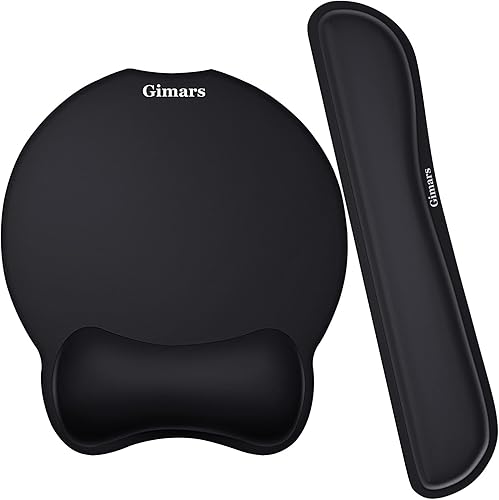
NPET Wrist Rest Mouse Pad Combo
NPET
- ✓Keyboard wrist rest + mouse wrist rest set
- ✓Memory foam
- ✓Non-slip backing
- ✓Multiple color options
Pros
- Keyboard and mouse wrist rest matched set at $20
- Matching aesthetics for both keyboard and mouse areas
- Best value for users who need both
Cons
- Memory foam quality is softer than Corsair or Glorious — less support
- Mouse wrist rest height is optimized for mousepad use, not bare desk
Best wrist rest combo for users who need keyboard and mouse wrist support at the same time. At $20 for both, it is good value despite slightly lower foam density than individual premium wrist rests.
Most people use their keyboard wrist rest exactly backwards.
They rest their palms on it while typing, which is the one time it can actually hurt them. Pressing down mid-keystroke tilts the wrist into extension, the opposite of what the pad is supposed to do.
Used correctly, during pauses between sentences rather than during active typing, a good wrist rest does real work reducing forearm fatigue over a long day.
We tested memory foam, cork, wood, and leather rests across six months of daily typing to see which held up. The Corsair Memory Foam Gaming Keyboard Rest came out on top, thanks to dual-layer foam that held its shape and stitched edges that outlasted every cheaper alternative we tried.
When to Use a Wrist Rest (and When Not To)
Use while: pausing between typing bursts, reviewing what you wrote, reading before responding, during video calls.
Do not use while: actively typing. Typing with palms pressed on a wrist rest raises the back of the hand relative to the keyboard, increasing wrist extension.
This is why some typists find wrist rests do not help — if you keep palms on the rest while typing, the wrist angle is often worse than without the rest.
Height Matching to Your Keyboard
Wrist rest height should match the keyboard's key height — the top of the rest should sit at approximately the same level as the space bar, so your wrist remains flat (neutral) when transitioning from rest to keys.
Most wrist rests are designed for standard mechanical keyboards at 35-45mm height. Low-profile keyboards (Apple Magic Keyboard, Logitech MX Keys, Keychron K3) are 20-25mm tall — most standard wrist rests are too tall for them.
Low-profile keyboard wrist rests are thinner (10-15mm) and sold separately. If you use a low-profile keyboard: buy a low-profile wrist rest specifically.
Ergonomic Considerations
Wrist rests are not required for ergonomic keyboard setups. The ergonomic goal is a neutral wrist position — neither extended (bent back) nor flexed (bent forward). A wrist rest helps achieve neutral by providing a surface to rest on during pauses.
However: if your desk is at the correct height for your arms (forearms parallel to floor), and your keyboard is low-profile, your wrists may naturally maintain a neutral position without a rest.
When a wrist rest helps most: standard mechanical keyboards (35-45mm tall), desk height slightly too high for the user, users who experience wrist fatigue during long sessions.
Material Comparison
Memory foam: conforms to palm shape, soft, comfortable. Loses some firmness over time (typically 1-2 years before noticeable compression). Most popular material for keyboard wrist rests.
Gel: firmer than memory foam, does not conform as much. Some users prefer the firmer support. Does not compress as much over time.
Cork: firm, natural material, antimicrobial. Does not conform. Best for users who prefer a very firm, consistent surface. Good moisture wicking.
Wood: rigid, aesthetic. Used in premium desk accessory setups (Grovemade, Oakywood). No cushioning — appropriate for users who want a firm surface and care about desk aesthetics.
Leather/PU leather: firm to semi-firm, premium aesthetic. Similar to wood but with some give. Wipes clean more easily than cloth or microfiber.
Sizing Guide
Wrist rest width should match your keyboard width:
- 60% keyboard (60 keys): approximately 300mm wide rest
- 65% keyboard (65-68 keys): approximately 310mm wide rest
- TKL keyboard (87-88 keys): approximately 430-360mm wide rest
- Full-size keyboard (104-105 keys): approximately 430-450mm wide rest
A wrist rest that is too wide overhangs on the sides and does not stay positioned correctly. A rest that is too narrow leaves parts of the wrist unsupported.
Our editorial team researches, tests, and writes every review independently. We never accept payment for placement.